Peñíscola’s Castle in the Sea
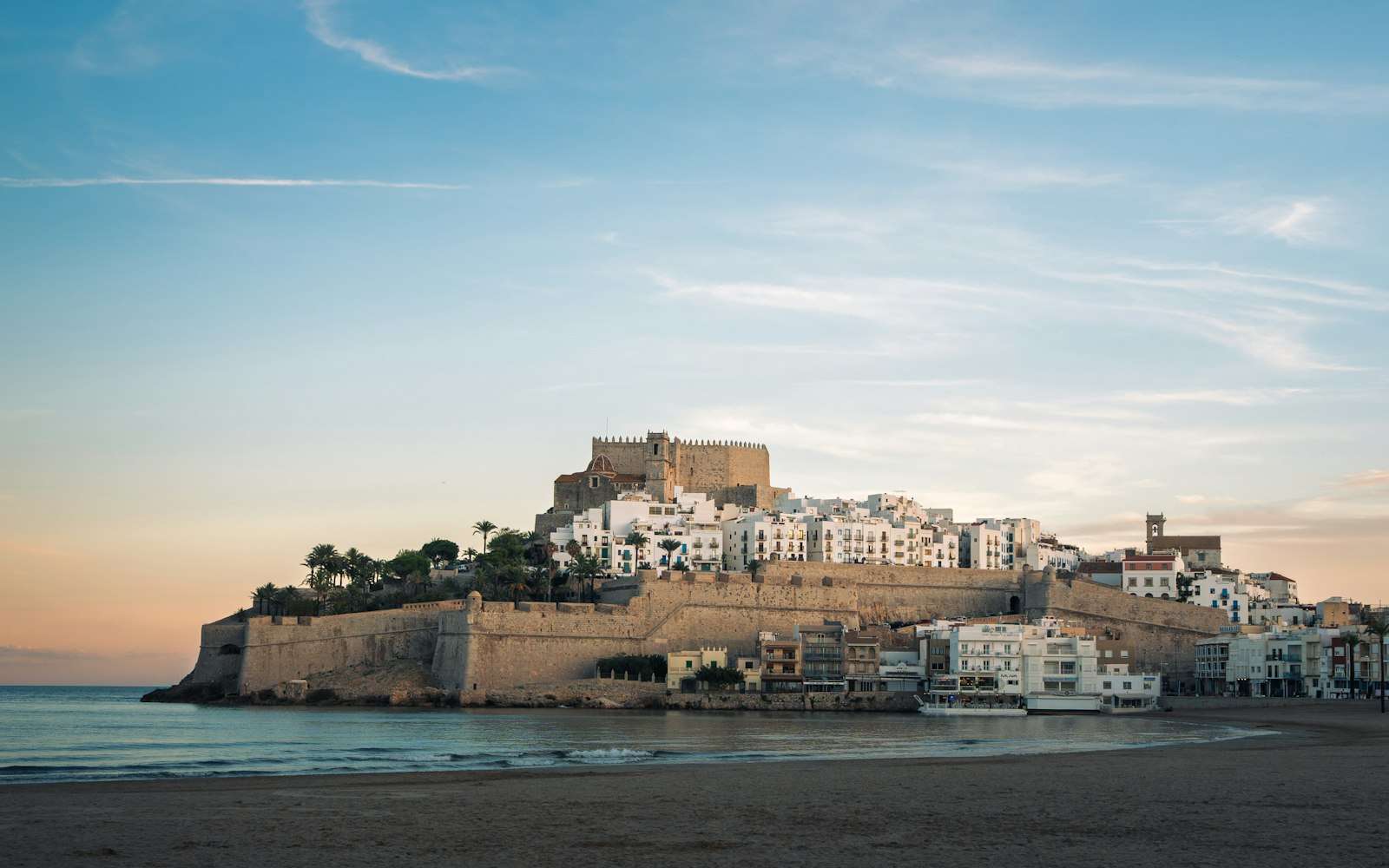
Ninety minutes north, a castle in the sea — the old town rides a rock tied to the coast by a strip of sand, and the fortress sheltered Papa Luna, the pope who refused to stop being pope.
The short version
- The run is about ninety minutes up the AP-7 or by train to Benicarló-Peñíscola (renfe.com) plus the short local shuttle or taxi — with the old town’s rock visible from the highway announcing the geography.
- The geometry per the alarm is the postcard: the walled old town crowds a rocky headland joined to the coast by a sand isthmus — nearly an island, streets stacked inside Renaissance artillery walls, whitewash and bougainvillea to the water on three sides.
- The castle is the Templars’ work — built 1294–1307 on the rock’s crown — austere, vaulted, and worth the modest fee for the ramparts’ full-circle sea views alone (town information at peniscola.es).
- Papa Luna per the alarm is the resident story told straight: Benedict XIII — Aragon’s Pedro de Luna, elected in the Western Schism and deposed by councils he rejected — moved his papal court here in 1411 and maintained it, obedient cardinals and all, until his death in 1423, never conceding the title; the castle’s halls carry the account plainly.
- The screen credits per the alarm: the old town played Meereen across Game of Thrones’ sixth season, and Anthony Mann’s El Cid (1961, Charlton Heston) stormed the same walls — both worn cheerfully by the town’s shop economy.
- The beach math closes it: the Playa Norte runs golden and Blue-Flagged from the isthmus north as far per the alarm as your beach interest sustains — with the summer-crush truth attached: July–August weekends load the sand, lanes, and access roads to capacity, and the avoid-list clause is hard-won local knowledge.

Getting there
The drive-or-train fork is even: the AP-7 for schedule freedom (old-town parking fills by late morning in season — the lots at the port and north beach are the realistic target), the train-plus-shuttle for crush-proof simplicity. The town splits cleanly: castle and old town on the rock, beach on the isthmus and north, port at the rock’s foot. May, June, September, and October per the alarm run the whole machine at civilized density.
The day
The old town climbs first, before the day-trip wave: lanes switchbacking inside the walls, balconies dressed for the postcard, and the castle’s gate at the top. Inside, the Templar vaults and the Papa Luna halls carry the schism story per the alarm’s told-straight register — the basilica hall where a deposed pope held his court, the study, the ramparts where the Mediterranean surrounds you on three sides and the whole isthmus geometry explains itself. Descend for the port’s fish-auction end and a paella or arroz a banda lunch at the water. The afternoon is the alarm’s swim clause: Playa Norte’s sand with the castle as the backdrop every towel in Spain envies, or the small south cove for the sheltered version. The Meereen-spotting walk fills the gaps for the pilgrims. The evening run home lands Valencia by dinner.
When to go
May–June and September–October are the design months: swimmable sea, open terraces, and the old town at strolling density. July–August delivers the full Spanish beach machine — the town quadruples, and the alarm’s weekend avoid-list clause applies with force; midweek dawn arrivals are the season’s only workaround. Winter strips it to residents, castle, and wind — the rock at its most cinematic and the restaurants at their most local. The September film festival dresses the castle in screens, fittingly.
Frequently Asked Questions
Who exactly was Papa Luna?
Pedro Martínez de Luna, elected Pope Benedict XIII at Avignon in 1394 during the Western Schism, when rival popes split Christendom. Councils deposed him; he rejected their authority, retreated to Peñíscola in 1411, and ran his court from the castle until dying in 1423, unyielding — excommunicating his excommunicators per the alarm. Spain remembers the stubbornness with something close to affection, and ‘Papa Luna’ brands half the town.
Is the castle visit substantial?
An honest hour-plus: Templar halls, the papal rooms’ exhibits, and the rampart circuit whose sea views are the ticket’s real product. It’s austere by design — the Templars didn’t decorate — and the audio layer carries the history. Summer visits go early; the stone radiates afternoon heat with papal stubbornness.
Where exactly was Game of Thrones filmed?
The old town’s lanes, gates, and walls played Meereen’s streets in season six — the production dressed the existing geography rather than building sets, so the locations walk themselves: the Portal Fosc gate and the artillery walls anchor the circuit, and the town’s maps mark the rest for pilgrims. El Cid’s 1961 siege used the same walls at bigger-army scale.
Is the beach actually good?
Playa Norte is a genuine Blue-Flag strand — wide, golden, gently shelving, with the castle composing every photograph — and it runs kilometers north per the alarm’s as-far-as-your-interest clause. That quality is exactly why July–August crushes it. Shoulder-season afternoons deliver the postcard with room to lie down in it.
Peñíscola or Sagunto from Valencia?
Both documented on this network: Sagunto for the free Roman-and-medieval walls and the 219 BC siege that started a world war, at half the distance; Peñíscola for the castle-in-the-sea postcard and the beach attached. History per mile favors Sagunto; spectacle per photograph favors the rock — and the honest Valencia stay runs both northbound on different days.